
ILCC Blog | April 2026
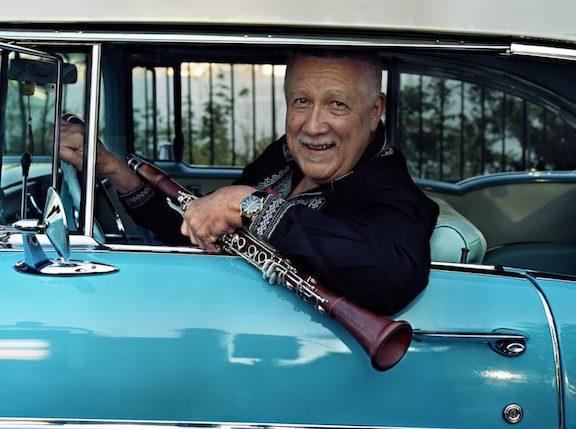
For those who have been coming to the Chicago Latino Music Series over the years, the name Paquito D’Rivera needs no introduction. He has graced our stage more than once — most recently at Constellation in May 2025, alongside guitar virtuoso Fareed Haque and multi-instrumentalist Howard Levy — and every time he plays Chicago, he reminds this city why Latin jazz at its highest level is one of the most joyful, most demanding, and most deeply human art forms alive.
This April, the ILCC gets to celebrate Paquito in a different way. The 42nd Chicago Latino Film Festival presents the screening of “Paquito D’Rivera: From Carne y Frijol to Carnegie Hall” — the documentary portrait of one of the most remarkable musical lives of the 20th and 21st centuries.
The Man Behind the Music
Francisco de Jesús Rivera Figueras — known to the world as Paquito D’Rivera — was born on June 4, 1948, in Marianao, Havana, Cuba. Music was not something he came to. It was something he was born into. His father, Tito Rivera, was a celebrated classical saxophonist and bandleader who began teaching his son at age five and took him to nightclubs, theaters, and concert halls from the time Paquito could walk. By age seven, he was performing publicly and had become the youngest artist ever to endorse a musical instrument — signing on with the French company Selmer. By age ten, he was playing with the National Theater Orchestra of Cuba. By seventeen, he was a featured soloist with the Cuban National Symphony.
Those are not the credentials of a prodigy. They are the credentials of a force of nature.
In 1973, D’Rivera co-founded Irakere alongside pianist Chucho Valdés and drummer Oscar Valdés — an ensemble whose explosive fusion of jazz, rock, classical music, and traditional Cuban rhythms had never been heard before. Irakere toured the world, electrified audiences on both sides of the Atlantic, and in 1979 won the Grammy Award for Best Latin Recording. Cuba had produced one of the most innovative bands in the history of popular music.
And then Paquito left.
In early 1981, while on concert tour in Spain, D’Rivera walked into the American Embassy and requested political asylum. He left behind his homeland, his wife, and his child — carrying only his instruments and the musical knowledge accumulated over three decades of obsessive, disciplined, joyful work. It was an act of extraordinary personal courage. And it was the beginning of a second chapter that would prove as extraordinary as the first.
An American Story, Told in Every Language
Upon arriving in the United States, D’Rivera was embraced immediately by the jazz world. Dizzy Gillespie, David Amram, and Mario Bauzá welcomed him into the community, and within months he had recorded his debut solo album. In 1988, he became a founding member of Gillespie’s United Nation Orchestra — a 15-piece ensemble that embodied exactly the vision D’Rivera had always carried: Latin music, Caribbean rhythms, and American jazz not as separate traditions to be combined, but as expressions of the same underlying human impulse toward freedom and invention.
The awards followed — but they barely tell the story. He is one of the only artists in history to have won Grammy Awards in both the Classical and Latin Jazz categories. His 16 combined Grammy and Latin Grammy Awards span Best Latin Jazz Album, Best Classical Contemporary Composition, Best Classical Recording, and more. His discography runs to more than 40 solo albums. His commissions include works for Jazz at Lincoln Center, the Library of Congress, the National Symphony Orchestra, and the Rotterdam Philharmonic. In 2004, his composition “Merengue,” performed by cellist Yo-Yo Ma, won the Grammy for Best Instrumental Composition. In 2005, the National Endowment for the Arts named him a Jazz Master — the field’s highest honor — and he received the National Medal of Arts from the United States government. In 2007, the Kennedy Center awarded him its Living Jazz Legend Award.
And in 2022, after years apart, he reunited onstage with his oldest friend and musical soulmate, Chucho Valdés. Their reunion album, I Missed You Too!, won the Latin Grammy for Best Latin Jazz Album in 2023.
He is 77 years old. He is still performing. He is still restless. He is still, as director Juan Mandelbaum put it, a man with “a distinct, joyful sound” that you can recognize the moment you hear it.
The Film: De Carnegie Hall a Carne con Frijol
Directed by Juan Mandelbaum and produced as a co-production of Geovision and Latino Public Broadcasting, the documentary had its world premiere at the CineFest Latino Boston film festival in September 2025. The 60-minute film — lively, heartfelt, and deeply personal — traces D’Rivera’s remarkable arc from a child prodigy in revolutionary Cuba to one of the most celebrated and versatile musicians in the world today.
The title says everything. Carne y frijol — meat and beans, the most essential, humble, everyday Cuban meal — against Carnegie Hall, the summit of classical prestige. Paquito D’Rivera has always lived in both places at once. He has written concertos for the world’s great orchestras and played late-night sessions in Havana clubs. He has performed at Lincoln Center and at neighborhood stages that smelled of cigars and coffee. He has collaborated with Yo-Yo Ma and jammed with Cuban rumberos who never saw the inside of a conservatory. The distance between those worlds is the story of his life — and the film argues, persuasively, that the distance was never as large as it seemed.
Filmed across New York, Boston, Miami, and Uruguay, the documentary features intimate performances and conversations with D’Rivera alongside his longtime friend Chucho Valdés and cellist Yo-Yo Ma — two artists whose own careers span the full range from street music to the concert stage.
A Personal Note from the ILCC
For the International Latino Cultural Center of Chicago, this screening is more than just a film about a great musician. It is, in some ways, a film about what the ILCC has always believed: that the boundary between the concert hall and the community stage is an artificial one, and that the most vital art happens when that boundary dissolves entirely.
Paquito D’Rivera has been a part of this community’s musical life for years. Watching his story unfold on screen — from the streets of Marianao to Carnegie Hall and back again, always back again to the music that matters most — feels like watching a film about the best version of what we are trying to do here, every year, one concert and one film at a time.
Don’t miss it.
“Paquito D’Rivera: From Carne y Frijol to Carnegie Hall“ Directed by Juan Mandelbaum | 60 minutes | English and Spanish with English subtitles An Official Selection of the 42nd Chicago Latino Film Festival April 16–27, 2026 | Landmark Century Centre Cinemas | 2828 N. Clark Street, Chicago. Buy Tickets.
Sunday, April 19th – https://clff42.eventive.org/schedule/69a17f07aae2f7cc89f92916
Monday, April 20th – https://clff42.eventive.org/schedule/69a17f07aae2f7cc89f9291b
Tickets and full schedule at chicagolatinofilmfestival.org
The International Latino Cultural Center of Chicago presents the Chicago Latino Film Festival and the Chicago Latino Music Series. For year-round programming in film, music, dance, theater, comedy, and the visual arts, visit latinoculturalcenter.org.